How Much Does Residential Landscaping Planning Cost Near T.C. Jester Park?
Residential landscaping planning near T.C. Jester Park does not have one reliable published price because the planning scope can range from a site estimate to a detailed design that coordinates planting, drainage, irrigation, pavers, and installation. The useful answer is to request a written scope tied to your actual project area, priorities, existing conditions, and desired deliverables.
Proximity to T.C. Jester Park alone does not create a special residential price. A property with mature trees, an older sprinkler system, limited access, or standing-water concerns may require more planning than an open yard with a straightforward bed refresh. Houston Heights Landscaping can help homeowners discuss residential outdoor improvement priorities and request an estimate or consultation.
Quick Answer
Ask first whether you are receiving a no-cost site estimate, a paid consultation, a conceptual layout, or a construction-ready landscape plan. These are different services, and a quote for one should not be assumed to include the others.
A planning estimate should identify the project area, requested features, site observations, drawings or selections included, revision allowance, and whether any planning amount is credited toward installation. If a provider cannot define those items, comparing prices will be difficult because you may be comparing different levels of work.
What type of landscape planning are you paying for?
The phrase “landscape design” can describe several very different deliverables. Clarifying the level of planning prevents a homeowner from expecting scaled drawings and material details from an estimate that was intended only to establish an installation scope.
Site estimate
A walkthrough and discussion used to understand priorities, visible conditions, approximate work areas, and a potential installation scope. It may not include a drawing or plant schedule.
Consultation
A focused planning conversation about layout, priorities, sequencing, plants, lawn, drainage, or outdoor-use goals. Confirm whether notes, measurements, or follow-up recommendations are included.
Conceptual design
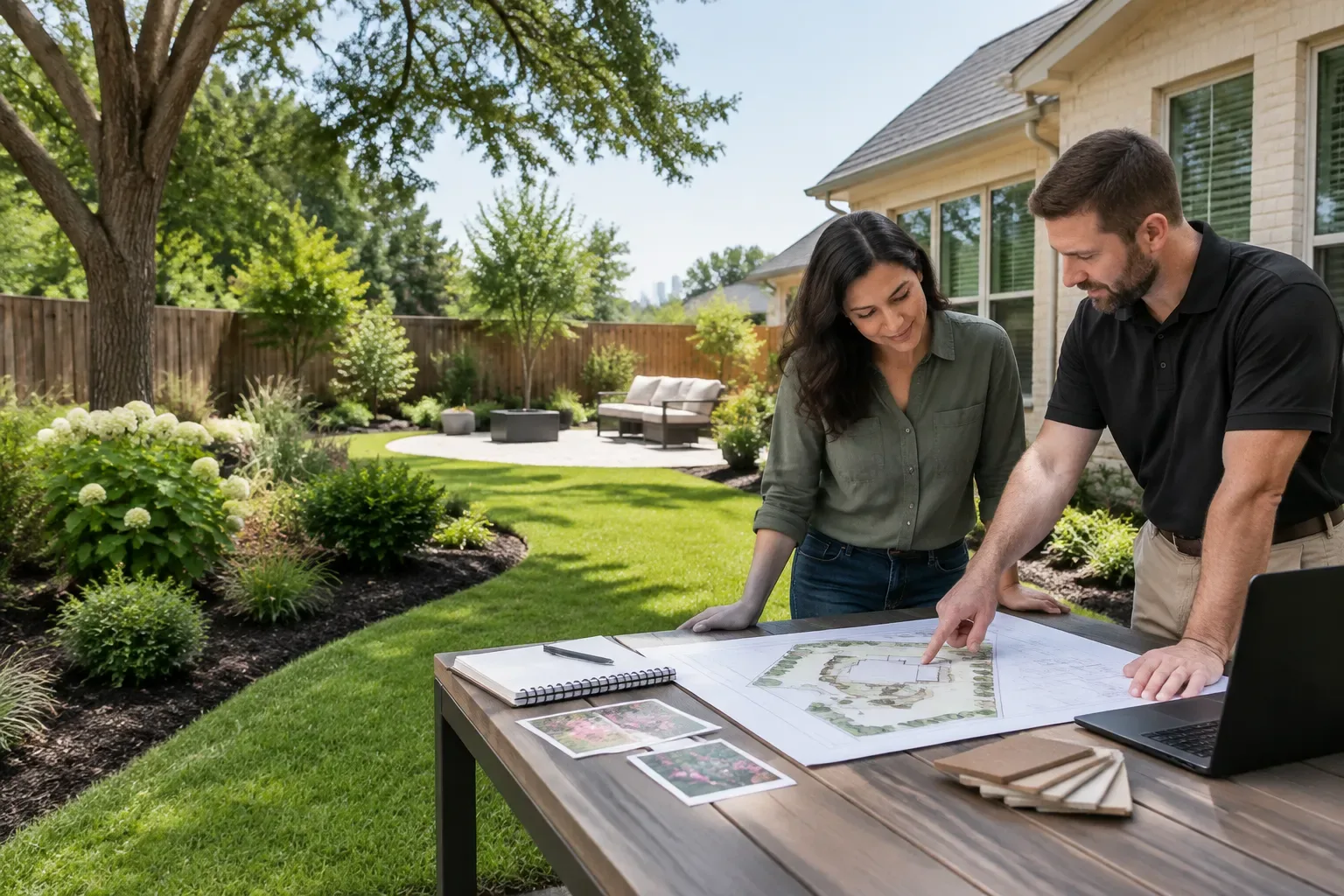
A visual direction for the space, such as bed locations, circulation, feature placement, and overall style. It is useful for making decisions but may not be detailed enough for construction.
Construction-ready plan
A more complete package that can address measurements, plant and material selections, irrigation or drainage coordination, and installation details. The required effort rises with site complexity.
For a broader view of available project types, review the company's landscaping services in Houston. The right level of planning depends on what you need to decide before installation begins, not on the size of the wish list alone.
Which site conditions raise planning complexity?
A clear plan accounts for conditions that could affect installation, performance, or maintenance later. On established residential lots, trees and roots, fences, patios, driveways, utility routes, existing beds, and access constraints can change where features can go and how crews reach the work area.
Houston's heavy rain events also make stormwater movement worth discussing early. Low spots, runoff routes, washed mulch, erosion near beds, and water moving toward a patio are observable symptoms, not proof of one specific problem. A site assessment may find that drainage coordination, grading work, gutter discharge, or a repair outside the landscape scope is needed before new planting is installed.
Existing irrigation deserves the same attention. New turf, plants, and beds need a watering approach that matches their needs. EPA WaterSense landscaping guidance explains why plant choice, soil, irrigation, and maintenance should be considered together in a water-efficient landscape approach. If sprinkler inspection, repair, extension, or redesign is needed, it should be identified as its own scope rather than silently folded into a planting allowance. Learn more about sprinkler installation and repair in Houston when water coverage is part of the project.
What should a written planning scope include?
A useful proposal makes it possible to see what is included, excluded, and still undecided. Before approving planning or installation, ask for the following in writing:
- Approximate project boundaries and measured or estimated work areas
- Intended use of each area, such as entry planting, privacy, play, entertaining, lawn replacement, or a path
- Site observations involving drainage, irrigation, trees, access, existing materials, and removal needs
- Drawings, plant selections, material selections, or product allowances included in the price
- Whether pavers, fences, lighting, pergolas, or outdoor-kitchen features need separate planning
- Number of revisions and the process for approving changes
- Installation assumptions, exclusions, and any work that requires another specialist
- Whether a planning fee is credited if you move forward with installation
A landscape plan is often most valuable when it separates decisions that need to happen first from items that can wait. Drainage correction or irrigation repair may belong in an earlier phase, while decorative planting or a patio expansion can follow once the site is ready.
How can you keep the planning process focused?
The most common mistake is asking for a quote for “the whole yard” without deciding what the space needs to do. That can produce a broad estimate that is difficult to compare, or a plan that includes attractive features while leaving an important practical issue unresolved.
- Define the priority area and its purpose, such as a front entry, backyard gathering area, lawn problem, privacy screen, or low-maintenance planting zone.
- Measure approximate dimensions, take photos from several angles, and mark existing features you want to keep or remove.
- Make a short list of must-haves, nice-to-haves, and concerns such as pooling water, poor sprinkler coverage, shade, or damaged beds.
- Ask for a written planning scope and confirm what drawings, selections, revisions, and site coordination are included.
- If the full vision exceeds the initial budget, request phased options that address drainage or irrigation before cosmetic improvements.
You can also review the company's available landscape and outdoor improvement services to identify related work that may need to be planned together, including flower beds, mulch, pavers, fencing, turf, and maintenance.
When is a simpler estimate enough, and when do you need a detailed plan?
A simple estimate may be enough for a defined refresh, such as replacing mulch, updating a contained planting bed, or installing a known lawn area with no apparent drainage or irrigation changes. It becomes less suitable when the project combines several systems or requires decisions that affect each other.
A more detailed plan is often practical for a yard that includes a new patio or path, multiple planting zones, drainage concerns, new irrigation coverage, major removals, fencing changes, or an outdoor living area. Detailed planning does not automatically mean a better project. It means the scope needs coordination before materials are ordered or work begins. For examples of the type of finished work that can inform your conversation, see the latest project page.
What should you do before approving a landscaping budget?
Compare scopes before comparing totals. One proposal may include demolition, drainage observation, sprinkler work, plant selections, and cleanup, while another may cover only installation of visible features. The lower number is not necessarily less expensive if essential work appears later as a change.
For a property near T.C. Jester Park, confirm the residential address and property boundaries during the consultation. This keeps the discussion centered on your lot and avoids confusing private residential work with any public park property. Bring photos, an approximate budget range you are comfortable discussing, and a list of priorities so the plan can be sized to the project rather than guessed from a broad description.
If you want help defining the scope, request a landscaping consultation or estimate with the project area, goals, and any drainage or sprinkler concerns noted in advance.
Ready to discuss your project?
Discuss your T.C. Jester Park-area landscape priorities, site conditions, and preferred planning scope with Houston Heights Landscaping.
FAQ
Is a landscape consultation the same as a landscape design?
Not necessarily. A consultation may be a conversation and site review that helps establish priorities and an installation direction. A design may add a layout, measurements, plant selections, material choices, and revision steps. Ask what tangible deliverables you will receive, whether the plan is scaled, and whether it is intended to guide installation or simply help you choose a direction.
Can I get an estimate without paying for a full design?
Often, a provider can discuss the site and prepare an installation estimate without producing a full design package. Confirm what that estimate includes before relying on it for comparisons. A quote based on a walkthrough may not include drawings, detailed planting selections, drainage analysis, or sprinkler redesign. For straightforward projects, that may be appropriate. For complex projects, more planning can reduce uncertainty.
Does drainage work add to landscape planning costs?
It can, because drainage concerns may require observation of runoff paths, low areas, existing grades, gutters, and nearby hard surfaces before a planting layout is finalized. Standing water or washed-out mulch does not prove a single cause. A professional assessment may identify a landscape issue, an irrigation issue, or a condition that should be handled by another qualified service.
Should sprinkler repairs be included before new plants or sod?
Usually, it is wise to inspect irrigation before installing areas that will depend on consistent watering. New sod, turf, and plants can struggle if coverage is uneven or damaged components remain hidden beneath the finished work. The Houston sprinkler service page outlines the related installation and repair service, but your property still needs an individual assessment to determine the actual scope.
What information should I bring to a landscape planning appointment?
Bring photos, approximate dimensions, inspiration images, a list of features to keep or remove, and your top priorities for the space. Include practical concerns such as water collecting in one area, failing grass, lack of privacy, or a route that needs a path. It also helps to say whether you prefer one complete installation or phased work over time.
Can a landscape plan include pavers, fencing, or an outdoor kitchen?
Yes, a broader outdoor improvement plan can coordinate these features with planting, circulation, irrigation, and drainage. They should be explicitly named in the scope because they may require different materials, installation methods, site preparation, and sequencing. A path or patio can redirect water, while fencing can affect access, so treating each feature as an afterthought can create avoidable revisions.
How do I compare two Houston landscaping estimates fairly?
Line up the written scopes item by item: removal, site preparation, drainage, irrigation, plant materials, lawn or turf, hardscape materials, access assumptions, cleanup, and design deliverables. Then list exclusions and allowances beside each total. If one estimate is vague, ask for clarification before choosing. A clear scope is more useful than a low total that leaves major items undefined.
Does being near T.C. Jester Park change what I should budget?
The nearby landmark does not by itself establish a planning price or special residential requirement. Your budget is shaped by the actual lot, work area, selected features, existing improvements, access, and conditions found during a site review. Focus the estimate on your property boundaries and the outcomes you want, rather than on proximity to the park.