
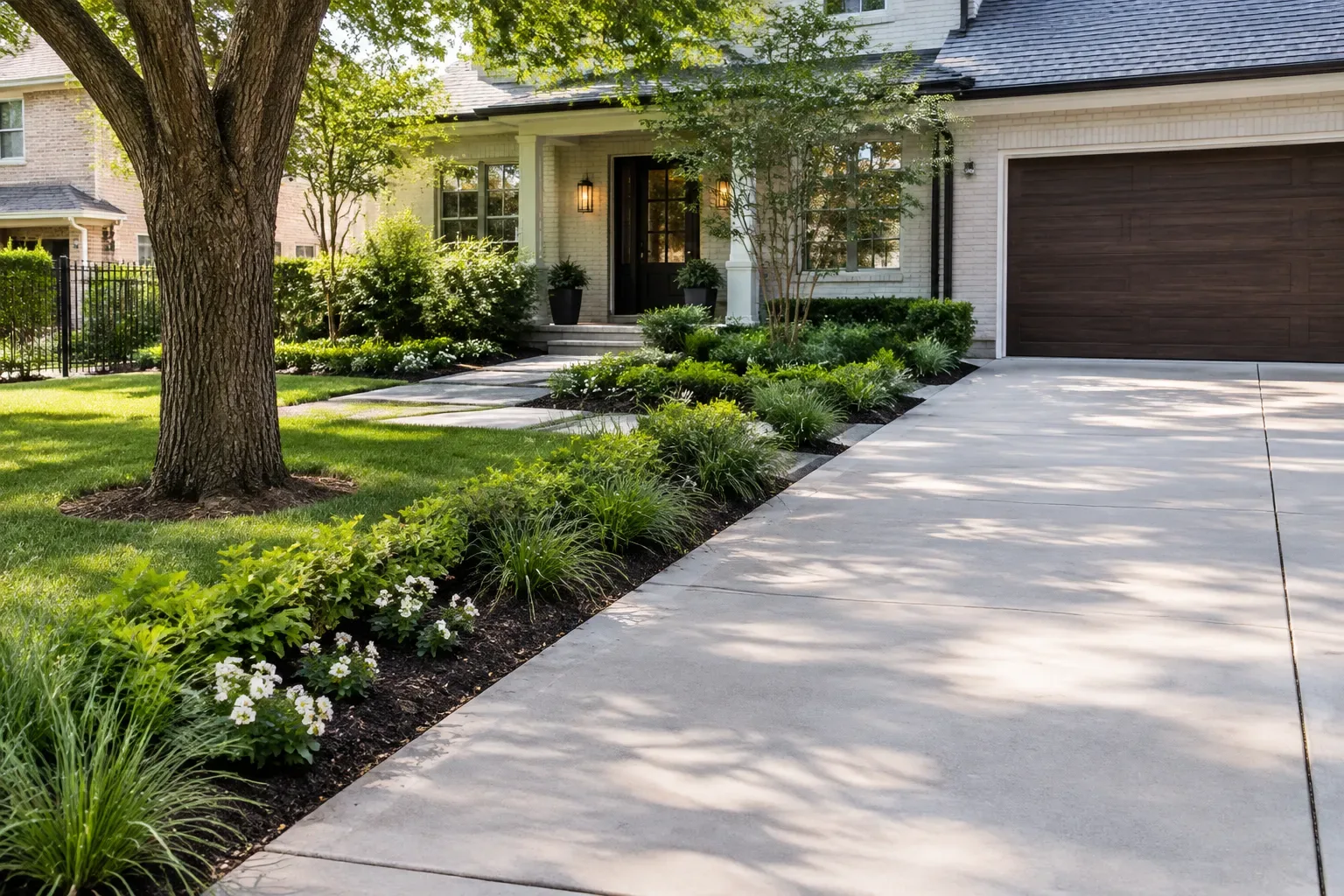
Can Landscape Design Balance Front Yards and Driveways Near Yale St in Houston Heights?
Yes. A well-planned landscape can make a driveway feel like part of the front yard instead of a strip of pavement that dominates it. The solution is not simply adding more plants. It is organizing vehicle access, the walk to the front door, sightlines, runoff, and maintenance space before choosing beds, edging, or plant material.
For properties near Yale St in Houston Heights, the most effective approach starts with the actual site dimensions. A narrow side strip may need a restrained, upright planting scheme, while a broader frontage may support layered beds, a defined walk, and a more substantial arrival area. Houston Heights Landscaping can help turn those measurements into a coordinated front-yard plan.
Quick Answer
Landscape design can balance a front yard and driveway by giving each area a clear job: the driveway remains easy to enter, exit, and maintain; pedestrian routes stay obvious; and planting softens hard pavement without blocking views or trapping water. Start with a measured layout, preserve open visibility near the drive entrance, and plan runoff before installing raised bed edges or dense planting.
What makes a driveway feel out of proportion to the yard?
The issue is often visual, not just physical size. An uninterrupted expanse of concrete draws the eye toward parked vehicles and away from the entry, lawn, trees, or planting beds. Sparse planting, disconnected materials, and an unclear front walk can make that effect stronger.
A balanced plan creates rhythm across the frontage. Repeated bed lines, a limited material palette, and plant groupings that relate to the home and pedestrian path can visually break up the pavement. That does not mean covering every available inch with plants. Open space is useful when it keeps the entry legible and gives the yard room to breathe.
The driveway itself can become an organizing axis. Its edge helps establish where a planting bed begins, where a person should walk, and where a lower planting zone is needed for safe visibility.
Which driveway-to-yard layout fits the available space?
The best layout depends on measured room between the driveway, home, sidewalk, property line, mature trees, and utilities. Avoid selecting a layout based on a photo before confirming those constraints.
Narrow planted edge
A slim bed along the drive can soften pavement where space is tight. Choose plants for their mature width, not their nursery-container size, so foliage does not regularly overhang the driving surface.
Entry-focused composition
Use a clearer front walk and more substantial planting near the entry when the driveway is visually dominant but the house needs a stronger focal point. This shifts attention toward arrival rather than parking.
Layered front bed
A wider frontage can support low plants at the drive, medium layers farther back, and trees or taller structure away from sightline zones. Repetition keeps the composition from looking busy.
Hardscape-led transition
Pavers, defined edging, or a small connection path can clarify pedestrian movement where turf and driveway edges currently meet awkwardly. The base and grading still need to move water appropriately.
For driveway edges, walks, and paver transitions, review the possibilities offered through hardscaping services in Houston. A hardscape detail should support the overall plan, not become a barrier that redirects runoff into the wrong place.
How should drainage shape the landscape plan?
Water movement needs to be understood before a bed is built. Driveways are impervious surfaces, so rain can shed toward planting areas, sidewalks, or the house. A raised edge, compacted soil, or a dense bed can unintentionally interrupt an existing flow path and lead to ponding, erosion, or stressed roots.
Look for observable conditions first: water remaining after rain, mulch washing onto pavement, bare spots at a bed edge, or soil settling beside the drive. These symptoms can point to runoff or compaction, but they do not prove a single cause. A site assessment may find grading issues, downspout discharge, damaged pavement, utility constraints, or a condition outside a landscaping scope.
Soil conditions should also be checked rather than assumed. The USDA NRCS Web Soil Survey can help identify mapped soil and drainage information for a property area, while an on-site review can reveal compaction and localized drainage conditions that a map cannot confirm.
If the plan includes drainage coordination, planting, mulch, and bed construction, landscape design and installation in Houston is a useful next step for tying the pieces together.
How can plants soften pavement without blocking the driveway?
Plan around mature height and spread. A small shrub can look harmless at installation but become a sightline problem or require repeated pruning once it reaches full size. Keep the zone nearest the driveway entrance and sidewalk visually open, particularly where a driver needs to see pedestrians, cyclists, and approaching vehicles.
Pavement also creates a different growing environment. Reflected heat can dry the bed edge faster than a planting area farther from concrete. Houston heat and humidity add pressure: plants need appropriate spacing for air movement, mulch to moderate soil moisture, and irrigation that matches sun exposure rather than a one-setting-for-everything schedule.
The EPA WaterSense landscaping guidance recommends matching plants to site conditions, grouping plants with similar watering needs, and maintaining irrigation thoughtfully. Those principles matter beside a driveway because runoff may already add water to some areas while reflected heat dries others.
Reserve taller planting or tree structure for locations where mature trunks, roots, canopies, overhead conditions, and visibility will not conflict with the driveway. Tree debris, root pressure, and pavement problems may require a tree or paving assessment rather than a planting-only solution.
What should be measured before requesting a design?
A simple field sketch makes a design conversation more productive. It also prevents a promising idea from being based on assumed dimensions.
- Measure the driveway width and length, then mark where vehicles turn, park, back out, and open doors.
- Mark the house, front walk, sidewalk, gates, property boundaries, utilities, downspouts, and mature trees.
- Photograph the frontage in the morning, afternoon, and after rainfall if possible, noting sun, shade, puddles, and runoff paths.
- Measure each potential planting strip at its narrowest point, not just at its widest point.
- List practical goals in order, such as less turf, a clearer entry, lower maintenance, privacy away from the drive entrance, or better drainage performance.
- Confirm applicable City requirements and any deed, utility, neighborhood, or property-line restrictions before construction.
This process is especially useful on established inner-loop lots, where available space can change significantly from one property to another. Measuring avoids the common mistake of specifying broad shrubs or deep beds for a strip that cannot realistically accommodate them.
How do irrigation and maintenance affect the finished look?
A front-yard design stays balanced only if it can be maintained without constant correction. Beds need enough access for weeding, mulch replenishment, pruning, and occasional plant replacement. Soil and mulch should be kept from migrating onto the driveway, where they can look untidy and create slick debris after rain.
Irrigation should follow zones with similar exposure and water needs. Avoid compensating for a hot pavement edge by overwatering the entire front yard. A focused review of sprinkler installation and repair in Houston can help determine whether existing coverage supports the new bed layout or needs adjustment.
A lower-maintenance design usually relies on fewer, repeated plant forms and materials, not on an oversized plant list. Mulch, selective turf, and well-placed hardscape can reduce exposed soil while leaving adequate room for roots and routine care.
When is landscaping not the complete answer?
Planting is not a cure for every driveway-adjacent problem. Cracked or settling pavement, persistent standing water, root-related heaving, a failing drainage route, or a driveway geometry issue may need evaluation before cosmetic work begins. Adding beds over the symptom can make later repair more disruptive and expensive.
Likewise, a wide driveway does not automatically need a major rebuild. Often, a clear entry walk, scaled planting, a consistent edge treatment, and a drainage-aware layout are enough to make the frontage feel more intentional. The right scope is the one that addresses the actual constraint, not the biggest possible project.
For a property-specific plan near Yale St, a consultation can clarify which improvements belong in the landscape scope and which need separate investigation. Request a landscape design consultation when you have a sketch, photos, or a few priorities ready to discuss.
Ready to discuss your project?
Share your driveway layout and front-yard goals with Houston Heights Landscaping for a practical design conversation near Yale St.
FAQ
How wide should a planting bed be beside a driveway?
There is no reliable universal width because the usable space depends on the driveway edge, vehicle-door clearance, pedestrian movement, mature plant size, and drainage route. Measure the strip at its narrowest point and select plants based on their mature spread. If the bed is very limited, use a restrained plant palette or focus the larger planting composition away from the pavement.
What are good low-maintenance ideas for a small Houston front yard with a driveway?
Use repeated plant forms, a clearly defined bed edge, mulch, and a limited number of materials. Small yards often benefit from concentrating the strongest planting around the entry or a single focal area rather than scattering many unrelated plants along every edge. Houston landscaping services can help coordinate planting, mulch, turf, and hardscape choices into one maintainable layout.
Can plants damage a driveway?
Some roots can contribute to conflicts with pavement over time, but a visible crack does not prove that roots caused it. Settlement, drainage, soil movement, and installation conditions can also be factors. Before placing a tree or large shrub near a drive, consider its mature root zone, trunk size, canopy, and future maintenance needs. Existing pavement movement may require a separate assessment.
How do I stop mulch from washing onto my driveway?
First, observe what happens during rain. Mulch movement may be caused by bed slope, driveway runoff, roof discharge, a low edge, or poorly contained soil. Refreshing mulch alone will not correct the cause. A suitable edge treatment, corrected runoff path, and stable soil surface can help, but the best solution depends on what an inspection finds.
Should I put tall shrubs at the end of my driveway for privacy?
Usually, the driveway entrance needs a low or open planting zone so drivers can see the sidewalk and approaching traffic. Taller screening may work farther from the exit point, where it does not interfere with views or vehicle movement. Plan for mature height, not the plant's current installation height, and keep pruning access in mind.
Do I need to change my sprinklers when I add driveway planting beds?
Possibly. New beds may have different sun, reflected heat, and watering needs than the turf they replace. They may also receive runoff from hard surfaces, so more irrigation is not always the answer. An irrigation review can confirm coverage, zone separation, and whether watering is being directed efficiently instead of toward pavement.
Can pavers make a front yard driveway area look less concrete-heavy?
Yes, pavers can create a more deliberate transition for a walk, entry connection, or small accent area. They should not be treated as an automatic drainage solution, though. Base preparation, grading, and runoff direction determine how the surface performs. A paver addition works best when it solves a circulation or visual problem without creating a new water-management problem.