
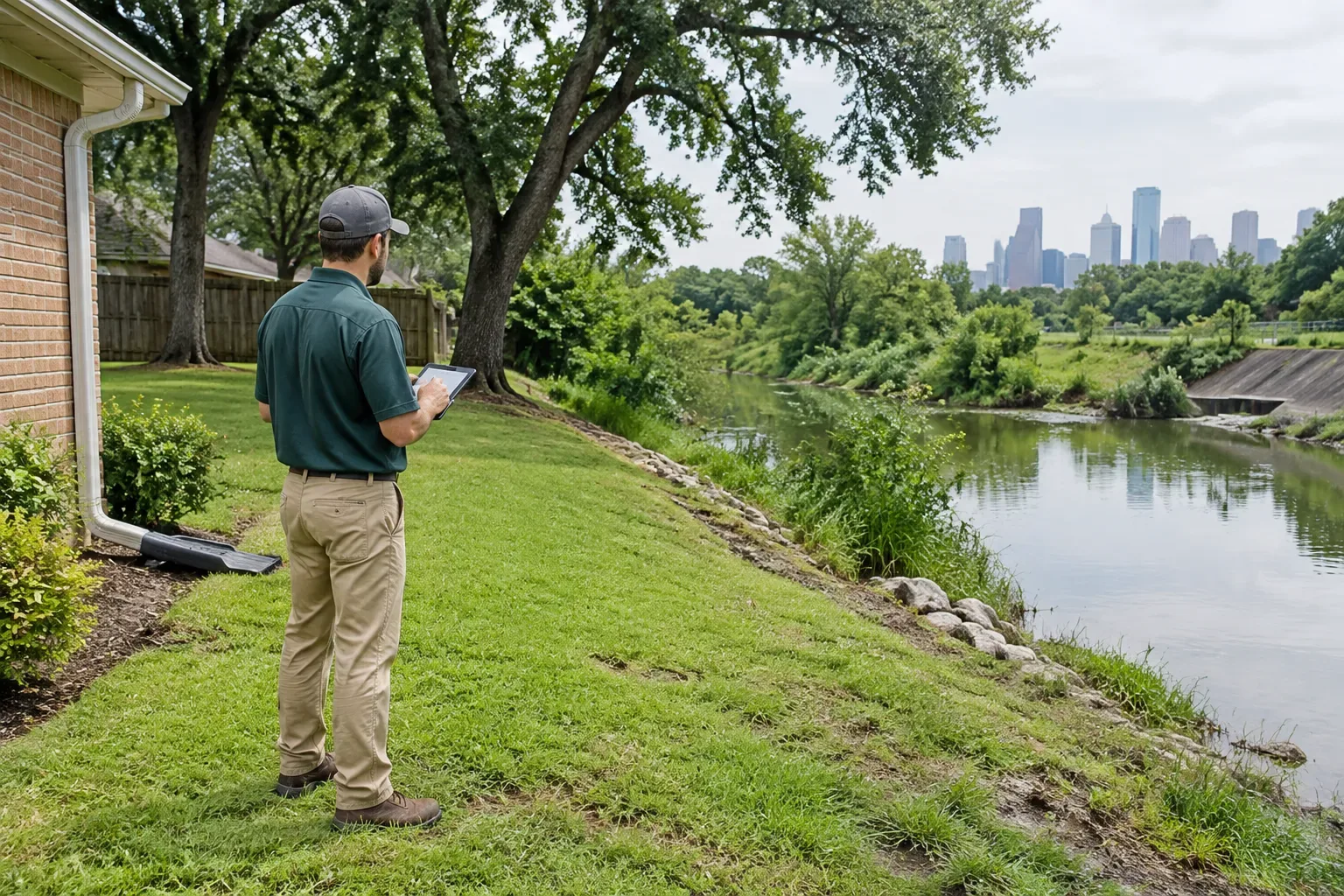
What Should a Landscape Contractor Review Near the White Oak Bayou Edge?
A landscape contractor should start with water, boundaries, and constraints, not plants or pavers. Near White Oak Bayou, the review should document existing drainage paths, ponding, downspouts, irrigation, mature trees, utilities, easements, and the parcel’s mapped flood-risk context before a final layout is proposed. White Oak Bayou is part of an identified Harris County watershed, so the relationship between the yard, drainage infrastructure, and the channel matters more than visual distance alone.
For a homeowner planning improvements near the bayou edge, the right scope may be ordinary landscape work, or it may need coordination with a surveyor, engineer, arborist, floodplain professional, or public authority. A good review makes that distinction early rather than promising that landscaping can solve every flooding concern.
Quick Answer
Before designing or installing a landscape near White Oak Bayou, a contractor should review:
- The actual property line, visible drainage features, utility locations, easements, and access routes.
- Current water movement during and after heavy rain, including ponding, erosion, gutter discharge, and low spots.
- Current official flood-hazard mapping and whether a mapped floodplain, floodway, drainage easement, or public facility affects the proposed work.
- Existing trees, soil condition, irrigation coverage, and areas with different sun or moisture exposure.
- Whether planned grading, pavers, fencing, planting, or outdoor features could block flow, require excavation, add fill, or limit maintenance access.
Houston Heights Landscaping can help homeowners begin the practical site-planning conversation for residential outdoor improvements in Houston.
Why is a bayou-edge landscape review different from an ordinary yard review?
A yard can look dry on the day of an estimate and still behave very differently during a heavy rain. Near a bayou, the relevant question is not simply whether water enters the yard from the channel. It is also whether the yard’s outfall slows when bayou levels are elevated, allowing runoff to remain longer or move back toward low areas.
White Oak Bayou is an identified Harris County watershed. That does not establish conditions on any individual parcel. It does mean a landscape plan should examine the yard as part of a connected drainage setting, including roof runoff, neighboring grades, drains, driveways, fences, and the route water takes away from the home.
What should be checked before a final landscape design is drawn?
The most useful site visit produces observations that can be compared with the proposed plan. Photos, rough measurements, and a marked layout are more helpful than a vague assurance that a yard will “drain better.”
- Mark the property limits, existing fences, paved areas, drains, downspouts, trees, utility features, and visible low points.
- Ask where water stands, how long it remains after rain, where mulch or soil washes away, and whether any gutter or irrigation discharge contributes.
- Review available floodplain, floodway, and drainage information for the parcel before locating permanent or excavation-heavy improvements.
- Map the proposed planting, lawn, irrigation, paver, fence, and outdoor-living areas against existing grades and maintenance access.
- Set a written scope that identifies what landscape work can address and what requires separate professional review or agency clarification.
The FEMA Map Service Center provides official flood-hazard mapping tools. Within the City of Houston, the owner or project team should also consult the city’s floodplain information and development guidance when proposed work may be affected by mapped conditions or development requirements. A landscape contractor can flag the need for that review, but should not substitute a visual yard inspection for a floodplain determination or survey.
Which water observations matter most before landscaping starts?
Start with symptoms the resident can actually observe. Standing water near the house, turf that stays soft, mulch washed into a drain, bare soil on a slope, and water collecting along a fence are all useful observations. They do not, by themselves, prove one cause.
Possible causes can include an undersized or blocked drain, roof runoff concentrated in one location, a grade that directs water toward a structure, irrigation overspray, compacted soil, neighboring runoff, or slow drainage during high-water conditions. A professional finding requires inspection of the grades, drainage features, discharge points, and site constraints.
The common mistake is installing a drain, swale, or raised bed without tracing where the collected water will go. A new feature can shift water toward a foundation, sidewalk, fence line, or adjacent property if the whole drainage path is not considered.
How should flood maps, easements, and drainage facilities affect the plan?
Flood-related mapping and legal site constraints are not interchangeable. A property may be outside one mapped area yet still have a drainage easement, utility conflict, or access requirement that limits where work can occur. Conversely, a yard may be near a bayou without every part of the parcel being subject to the same limitation.
Before finalizing fill, grading, a patio, a fence, or a fixed outdoor feature, identify the relevant parcel lines and look for easements, public drainage facilities, culverts, inlets, and access paths. Harris County floodplain-management guidance is a useful starting point for understanding why official review may be necessary. Written clarification from the applicable authority is wiser than assuming a feature is allowed because a neighboring yard has something similar.
This is also where a landscape contractor should draw a clear boundary. Basic planting, lawn work, and surface improvements may fit within a normal landscape scope. Surveying, floodplain determinations, engineered drainage design, structural retaining work, and agency approvals may require other qualified professionals.
How should planting and irrigation change across a wet-to-dry yard?
One irrigation schedule rarely serves every part of a bayou-adjacent yard. A shaded tree zone, a sunny higher lawn, a low area that holds moisture, and a narrow bed beside paving can have very different water needs. Grouping plants and irrigation zones by actual conditions helps avoid adding unnecessary water to an already damp area while neglecting a hotter, faster-drying one.
Low or periodically wet planting areas
Use plants only after confirming their tolerance for periodic saturation, heat, and the expected mature size. Protect bare soil while new roots establish, because loose soil and mulch can wash toward drains or the bayou.
Typical lawn and planting zones
Match turf, bed preparation, and watering to the amount of sun, compaction, and drainage actually present. Watch for weak turf or shallow-rooted plants that reveal a recurring moisture problem.
Elevated, sunny, or paved-edge zones
These locations may dry faster and receive reflected heat. They often need separate irrigation management from lower areas, especially where overspray could wet pavement, foundations, slopes, or drainage features.
Existing tree roots deserve the same attention as water. Mature trees can limit trenching, excavation, grade changes, and soil compaction. A contractor should review canopy, root-zone, access, and utility conflicts before installing irrigation, edging, pavers, lighting, or new beds nearby.
For systems that need inspection, adjustment, or repair, review sprinkler installation and repair in Houston as a next step. The goal is not to irrigate every area equally. It is to keep water off hard surfaces and out of problem zones while giving each planting area appropriate coverage.
Can pavers, fences, and outdoor features be placed near the bayou?
They can be part of a suitable plan, but they need a more careful review than decorative planting alone. Pavers, patios, pergolas, outdoor kitchens, fencing, raised features, and substantial edging may require excavation, alter surface flow, add material, or create a barrier where water previously moved. Their location also has to respect property boundaries, trees, utilities, easements, and maintenance access.
A smaller, permeable or carefully graded solution may make sense in some yards. In others, the better answer is to keep a low area open and direct outdoor living features to a higher, better-drained portion of the property. Bigger is not automatically better, especially where a design would concentrate runoff or complicate access.
Explore Houston landscaping services for planning that connects planting areas, lawns, pathways, and outdoor spaces instead of treating each feature as a separate project. For hardscape-focused questions, the company’s hardscaping information can help frame the conversation around pavers and other built features.
What should happen during construction to protect drainage and soil?
The plan matters, but so does the installation sequence. Exposed soil, stockpiled mulch, loose rock, and disturbed ground can move during a strong storm before planting is established. Contractors should identify how bare areas will be stabilized, keep materials from entering inlets, and avoid compacting sensitive areas unnecessarily.
Federal stormwater rules can apply to certain construction activities that disturb soil, depending on project size and jurisdiction. The EPA’s construction stormwater guidance explains why erosion and sediment controls matter. That does not mean every residential landscape project has the same permit obligation, but it does reinforce a practical standard: do not allow disturbed material to wash into drainage infrastructure or the bayou.
Access is another construction issue. Equipment routes should be planned to reduce damage to established trees, lawn areas, and drainage features. A contractor should also avoid burying cleanouts, blocking drainage inlets, or leaving new grades that trap water against structures.
What should be included in a written scope for this type of project?
A written scope should connect the visible issue to the proposed work. It should identify the work area, existing conditions observed, intended grades or drainage direction where applicable, materials, irrigation adjustments, planting zones, tree-protection expectations, and how disturbed areas will be stabilized.
It should also state what is outside the landscape scope. Examples include boundary surveying, floodplain verification, engineering, structural design, utility relocation, and approvals from the relevant authority. That clarity protects the homeowner from mistaking an attractive concept plan for a complete flood-control solution.
For a broader view of available residential outdoor improvements, see the company’s landscaping services overview. Reviewing the latest project page may also help homeowners organize ideas before discussing a site-specific layout.
What is the most practical takeaway before hiring a contractor?
Ask for a plan that begins with where water goes, what site restrictions exist, and what must remain accessible. Then choose planting, irrigation, and built features that fit those conditions. A landscape improvement can make a yard more usable and resilient, but it should never be sold as a substitute for floodplain review, engineering, or public-drainage coordination when those are needed.
If you are planning residential landscaping near the White Oak Bayou edge, request a site consultation with Houston Heights Landscaping to discuss the visible site conditions and project goals.
Ready to discuss your project?
Discuss a drainage-aware landscape plan for your property near the White Oak Bayou edge with Houston Heights Landscaping.
FAQ
Do I need a flood map check before landscaping near White Oak Bayou?
A flood map check is sensible before finalizing work that involves grading, fill, a patio, fencing, or fixed outdoor features near the bayou. It helps distinguish proximity from actual mapped flood risk. Use the official FEMA map tool and, where applicable, City of Houston guidance. A map review is not the same as a survey or site-specific determination, so ask the appropriate professional if boundaries or restrictions are unclear.
Can landscaping stop my yard from flooding after heavy rain?
Sometimes landscape changes can improve local surface drainage, redirect roof runoff, stabilize bare soil, or reduce water pooling caused by a small grade problem. They cannot guarantee protection from major rainfall, bayou conditions, blocked public infrastructure, or regional drainage limits. The first step is identifying where water starts, where it collects, and where it can safely exit without shifting the problem to a building or neighboring property.
What should I do if mulch keeps washing toward a drain?
Treat washed mulch as a symptom, not a diagnosis. Check for concentrated downspout flow, excessive slope, sparse planting, irrigation runoff, or exposed soil around the bed. A contractor may recommend stabilizing the soil, changing bed edges, adjusting the mulch depth or placement, or revising the runoff path. Do not simply add more loose material if heavy rain is carrying the existing mulch into an inlet.
Should irrigation run less often in a low area near the bayou?
Often, low or slow-draining zones need a separate schedule from sunny, elevated lawn areas, but the correct adjustment depends on soil moisture, plant needs, shade, and actual drainage. Look for overspray, consistently soft soil, weak turf, or plants showing stress. A review of Houston sprinkler installation and repair can help identify zoning or coverage issues without assuming irrigation is the only cause.
Can I install pavers or a patio in a flood-prone yard?
Possibly, but first evaluate mapped flood conditions, existing grades, access, utilities, and how the new surface changes runoff. A patio in the wrong low area can create a flow barrier or concentrate water at its edge. A smaller feature in a higher location, a different material choice, or leaving a drainage route open may be more appropriate. Confirm any applicable official requirements before construction.
Who checks drainage easements before a landscape project?
The property owner should obtain reliable property and title information, and a surveyor may be needed to confirm boundaries or easement locations. A landscape contractor can identify visible drainage features and flag potential conflicts, but should not guess at legal limits. This matters before trenching, planting trees, setting fence posts, adding hardscape, or making grade changes in an area that may need utility or drainage access.
Are mature trees a concern for drainage and landscape work near the bayou?
Yes. Tree roots, canopy, and soil conditions can affect where drainage lines, irrigation trenches, pavers, and new planting beds can go. Excavation and compaction near established trees can damage roots, while grade changes can alter moisture around them. If a tree’s condition or stability is in question, that concern may be outside ordinary landscaping and should be evaluated by an appropriately qualified tree professional.
What should I ask for in a landscape estimate near White Oak Bayou?
Ask the contractor to identify observed drainage conditions, proposed work areas, materials, irrigation changes, and how exposed soil or loose materials will be managed during installation. Request clear limits on what is not included, such as surveying, engineering, floodplain verification, or permits. The Houston landscaping services page is a helpful starting point for aligning a landscape plan with lawns, beds, pathways, and outdoor spaces.